
Squirrels As Songbird Listeners
If you’ve ever spent time watching your backyard come alive, you may have noticed something that feels almost like teamwork: birds suddenly erupt into chatter, squirrels freeze or flick their tails, and for a moment the whole scene feels coordinated. At Raging Pixels, where squirrels and birds are the daily stars of the show, this kind of interaction isn’t just entertaining—it’s a glimpse into a subtle, fascinating survival network. While they may compete for seeds now and then, squirrels and birds often benefit from paying attention to each other’s warnings.
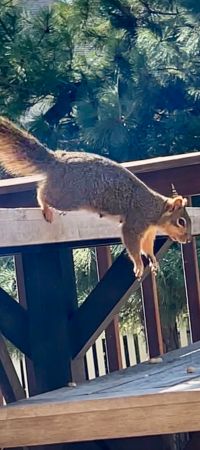
In the wild, survival depends on awareness, and many animals rely on what scientists call “mixed-species communication.” Birds are especially well-known for their alarm calls—sharp, repetitive sounds that signal danger. Different calls can even indicate different threats. For example, many small songbirds will produce a high-pitched, rapid chirping when a hawk is overhead, a sound that travels quickly and is hard for predators to locate. Squirrels, constantly scanning both the ground and the sky, appear to recognize these alarm calls. When birds sound the alert, squirrels will often freeze, flatten themselves against a tree, or dart for cover. Our blue jays are good about giving a warning call, when a hawk is near. On the other hand, when the blue jays feel like being greedy, they will mimic the hawks call and scare off their competition.
Squirrels, for their part, have their own warning system. If you’ve ever heard a squirrel “barking” or making a sharp kuk-kuk-kuk sound, that’s not random noise—it’s an alarm call. These vocalizations are often paired with dramatic tail flicks, which act as a visual signal. While these signals are primarily meant for other squirrels, birds seem to take notice. A sudden burst of squirrel chatter can send nearby birds into a heightened state of alertness, sometimes causing them to pause feeding or take flight. It’s not a formal language exchange, but it’s clear that both groups are tuned into each other’s cues.
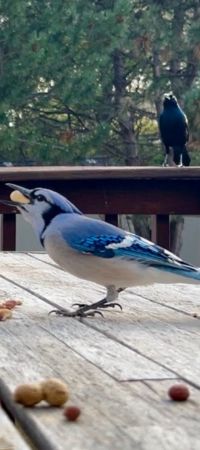
Interestingly, the type of danger influences the response. Birds are especially good at spotting aerial predators like hawks, while squirrels are more sensitive to ground-based threats such as cats, foxes, or even humans approaching too closely. This creates a kind of complementary awareness system: birds act as the early warning radar for the sky, and squirrels help monitor what’s happening on the ground and along tree trunks. By reacting to each other’s signals, both increase their chances of avoiding danger. A funny observation; we have three indoor cats that don't ever go outside, but look out the screen door regularly. The squirrels have zero fear of the indoor cats. I think they know that these cats are not going past the doors threshold!
What makes the relationship between squirrels and birds so compelling, is that it isn’t cooperation in the way humans usually think of it—there’s no conscious agreement or shared plan. Instead, it’s a byproduct of evolution, where animals that pay attention to the warning signs of other species simply survive longer. Over time, this creates an informal but reliable network of communication. Your backyard becomes more than just a feeding ground; it becomes a living, breathing information system.
So the next time you’re watching the antics unfold on Raging Pixels, keep an ear out as much as an eye. That sudden chorus of chirps or that emphatic squirrel scold might not just be noise—it could be a neighborhood-wide alert system in action. Beneath the playful chases and snack-stealing drama, there’s a quiet intelligence at work, reminding us that even the smallest backyard creatures are part of a much bigger, beautifully connected world.